
AI
Fundamentals
What Every Professional Needs to Know About AI
The real story behind the tools you’ve been hearing about, and how to use them with confidence.
Why this matters
AI isn’t futuristic anymore. It’s baked into tools you use daily, from Microsoft 365 Copilot to ChatGPT. Knowing how AI works (and what it does not do) is essential for staying relevant and effective at work.
This resource is for professionals in finance, HR, operations, and admin who want to cut through the hype and get practical about AI.

AI basics
AI is math, not magic. It predicts outcomes based on patterns in massive datasets.
What AI is good at |
What AI is not |
| Summarizing text | Human judgment |
| Suggesting next steps | Common sense |
| Rewriting documents | Emotional intelligence |
| Recognizing trends in data |
AI is assistive, not autonomous.
Top tools
From workplace assistants to creative copilots, here are some tools shaping today’s workflows:
- Microsoft 365 Copilot: AI built into Excel, Word, and Outlook
- ChatGPT: conversational AI for drafting, brainstorming, and Q&A
- Claude: context-heavy assistant tuned for long documents
- Grammarly AI: writing assistance with tone and style suggestions
Each tool has strengths, but none are “one click” magic. They need your input and judgment.
How AI helps
AI is already supporting professionals by:
- Drafting documents and emails faster
- Automating routine HR or finance tasks
- Spotting trends in reports and spreadsheets
- Summarizing meetings into action items
Even small time-savers add up, freeing teams to focus on meaningful work.
Prompting
Not all prompts are created equal. An “okay” prompt might get you something useful, but a “better” prompt (read: more specific) will give you sharper, more relevant results.
Here are examples to try:
Example 1: Summarize a meeting into three bullet points
- Okay prompt: “Summarize this meeting.”
- Better prompt: “You are an executive assistant summarizing a leadership team meeting for the COO. Provide 3 concise bullet points on key decisions made, and list next steps with clear owners and deadlines.”
Example 2: Draft an onboarding checklist
- Okay prompt: “Make an onboarding checklist.”
- Better prompt: “You are an HR specialist creating an onboarding checklist for a Finance Coordinator at a 50-person SMB. Include systems access, policy training, and intro meetings for week 1.”
Example 3: Rephrase an email professionally
- Okay prompt: “Make this email more professional.”
- Better prompt: “You are a communications coach helping a team lead respond to a vendor delay. Tone should be firm but respectful, preserving a positive relationship.”
Example 4: Suggest improvements to a policy
- Okay prompt: “How can I improve this policy?”
- Better prompt: “You are an operations manager reviewing a remote work policy for 100 employees. Suggest three improvements to make the policy clearer, easier to enforce, and aligned with hybrid best practices.”
Adoption method
Rolling out AI at work does not need to be overwhelming. Start with a clear framework:

- Discover: Identify repetitive, time-wasting tasks
- Pilot: Test one tool with one use case
- Train: Establish AI do’s and don’ts for your team
- Prepare: Organize your data and documents for AI use
- Scale: Expand adoption where results are proven
When you feel ready to move beyond quick wins, explore our guide to building a long-term AI strategy for SMBs.
Ethics and risks
Use AI wisely. Keep in mind:
- Bias: AI learns from imperfect data
- Privacy: Do not feed it sensitive or confidential info
- Accuracy: AI can generate false or misleading content
- Transparency: Always verify before acting
Think of AI as a co-pilot, not an autopilot. For more on the risks of unsanctioned AI use, see our guide on how to protect your business from shadow AI.
What to remember
AI is not going to replace you, but someone using it wisely might.
The professionals who thrive will not necessarily be the most technical. They will be the most thoughtful: The ones who use AI to enhance judgment, efficiency, and creativity. Start by picking one repetitive process this week and try optimizing it with AI.
Want to explore how AI can support your business strategically?
Talk to us about AI adoption at your workplace.
While you’re here…
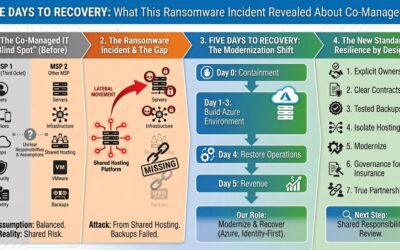
Five Days to Recovery: What This Ransomware Incident Revealed About Co-Managed IT
The blind spots that can turn shared IT into shared risk Two MSPs. One ransomware incident. The attack didn’t come from phishing.It came from shared infrastructure managed by another provider. Backups were assumed to exist.Some didn’t. The business went offline. Five...

Onsite IT vs Remote IT: The Myth of Presence and What SMBs Need
Many SMBs believe onsite IT is essential, even though most support tasks are now handled remotely. This article explains why the onsite model persists, when onsite work is still needed, and how remote-first IT improves speed, security, and scalability for growing organizations.

MSP Buyer’s Guide: How to Choose the Right IT Partner
How to Choose a Managed IT Services Partner You Can Trust TL;DR Most businesses struggle to evaluate MSPs because the industry is inconsistent, jargon-heavy, and full of providers who overpromise and underdeliver. This guide gives you a clear, structured checklist to...