
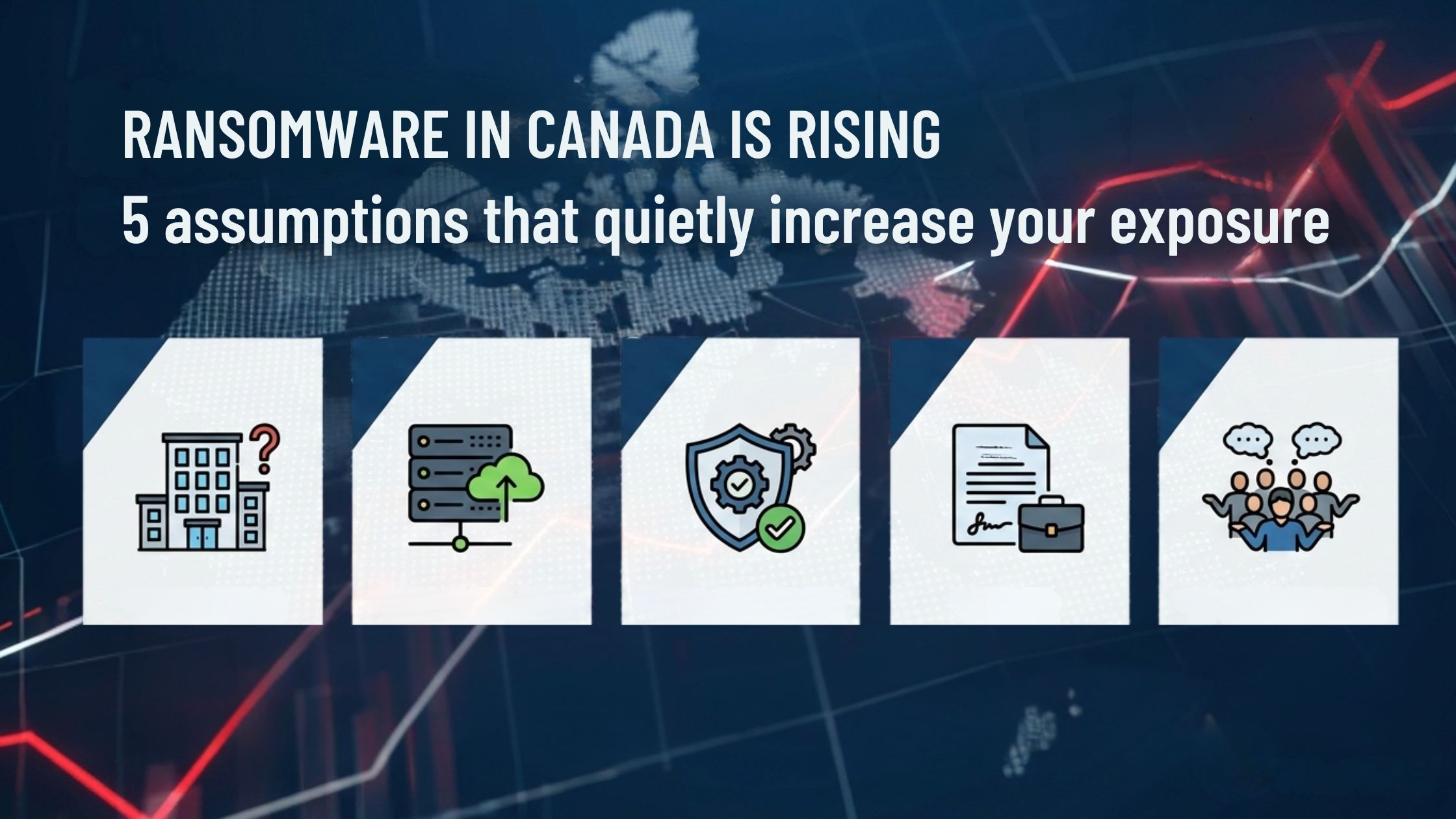

Why Canadian SMBs are overestimating their ransomware readiness in 2026
The Canadian Centre for Cyber Security reports that ransomware incidents known to the Cyber Centre have increased by an average of 26% per year since 2021.¹
That’s not just a statistic. It’s a signal.
In its latest Ransomware Threat Outlook 2025–2027, the Cyber Centre describes how ransomware operations are maturing and where Canadian organizations remain vulnerable.
For many SMB leaders, the challenge is not awareness. It’s knowing which “we’re covered” beliefs hold up under pressure, and which ones don’t. Throughout this article, we also outline the “Third Octet Way” – how we help organizations reduce ransomware exposure through governance, operational discipline, and measurable readiness.
Here are five common assumptions that quietly increase exposure, plus what to validate next.
1) “We’re too small to be a target.”
Ransomware groups rarely prioritize victims by company size. They prioritize access and opportunity, including:
- weak authentication,
- limited visibility,
- unmonitored endpoints,
- unverified backups, and
- shared or poorly segmented infrastructure.
Small and mid-sized businesses often have uneven security maturity. If anything, that makes them attractive, not invisible.
If your organization stores financial data, client information, intellectual property, or depends on digital systems for daily operations, you are part of the modern attack surface.
Small does not equal safe.
The Third Octet Way: We reduce opportunity, not just risk, by embedding identity governance, continuous monitoring, segmented infrastructure, and verified continuity into our Workplace Suite as standard components – not optional add-ons.
2) “Backups are our plan.”
Backups are essential. However, they are not a ransomware strategy in and of themselves.
Modern ransomware campaigns commonly:
- attempt to encrypt or delete backups,
- target administrative credentials,
- exploit shared hosting environments, and
- exfiltrate data before encryption (double extortion).
A backup only protects you if it is:
- immutable (cannot be changed or deleted for a set period),
- segmented from production systems,
- regularly tested, and
- restorable within your required recovery window.
For a real-world example, see our case study: Five Days to Recovery: What This Ransomware Incident Revealed About Co-Managed IT.
Backups can reduce downtime. They do not eliminate risk, especially if they are untested or poorly governed.
The Third Octet Way: Within our Workplace Suite, backups are treated as governed assets, with immutability, segmentation, documented recovery objectives, and scheduled restoration testing embedded into operational cadence – not assumed.
3) “Our security tools will stop it.”
Most organizations have some combination of:
- endpoint protection,
- email filtering,
- multi-factor authentication,
- firewall controls.
Tools help, but tools are not readiness.
We often see environments where:
- MFA is not enforced everywhere (especially for privileged access),
- endpoint detection is deployed but poorly configured,
- logs are not centrally monitored, and
- Incident response ownership is unclear.
Security maturity depends on governance, visibility, and accountability, not just software.
If you cannot clearly answer:
- How would we detect ransomware early?
- Who leads containment?
- How quickly can we isolate compromised systems?
- When was our last recovery test?
…then your organization is not as prepared as it may feel.
The Third Octet Way: We focus on operational readiness over tool accumulation, aligning detection, response ownership, centralized logging, and privilege control into a measurable security framework that is continuously reviewed and improved.
4) “Cyber insurance will cover it.”
Cyber insurance is increasingly becoming a financial necessity for Canadian SMBs.
However, insurance does not prevent incidents. Coverage may also be delayed, reduced, or denied if required controls are not properly implemented or documented.
Insurers now commonly require evidence of:
- MFA across critical systems,
- endpoint detection and response,
- tested, immutable backups,
- patch management automation,
- privileged access governance, and
- documented incident response processes.
If you’re evaluating whether coverage makes financial sense, or whether your controls align with underwriting expectations, see: Protecting Cash Flow and Continuity: Why SMBs Need Cyber Insurance Now.
Insurance can absorb financial shock. It does not replace operational discipline.
The Third Octet Way: We align technical controls, documentation, and governance practices with underwriting expectations so insurance becomes a resilience layer – not a substitute for operational discipline.
5) “If something happens, we’ll figure it out.”
Ransomware response under pressure, without predefined ownership, gets expensive fast.
SMBs of all types, whether internal IT teams, single providers, or co-managed setups, often face confusion over:
- who owns identity and access,
- who validates backup integrity,
- who rebuilds systems,
- who leads crisis communications, and
- who has decision authority when tradeoffs get real?
When responsibilities are predefined and documented, recovery accelerates.
When they are not, confusion compounds damage.
Hope is not a strategy.
The Third Octet Way: We define ownership, escalation paths, communication protocols, and recovery playbooks in advance, so when pressure rises, execution is deliberate rather than reactive.
What this means for Canadian businesses
A sustained increase in ransomware activity reflects a broader pattern:
- threat actors are scaling operations,
- automation is increasing,
- targeting is becoming more opportunistic, and
- recovery costs continue to rise.
Many leadership teams overestimate their level of protection, not because they are negligent, but because readiness has not yet been aligned with current guidance.
A practical next step: get a clear picture of your readiness
If you’re not sure how your environment stacks up, a structured Ransomware Readiness Review can help you quickly validate the basics and surface hidden gaps.
This isn’t a full audit. It’s a focused working session designed to answer questions leaders actually have, such as:
- Where are we most exposed right now?
- Which controls are strong, and which are assumed?
- If we had an incident tomorrow, what would slow containment or recovery?
- Are we likely to meet common cyber insurance expectations?
We review:
- MFA coverage and enforcement,
- endpoint detection configuration,
- backup immutability and testing history,
- monitoring and logging visibility,
- incident response ownership, and
- alignment with common underwriting requirements.
You leave with:
- a clear gap summary,
- a prioritized risk list, and
- a practical improvement roadmap.
No scare tactics. No obligation. Just clarity, and the next best steps.
Ready for a clearer picture of your readiness?
Book a free Ransomware Readiness Review
FAQs
What should an SMB ransomware response plan include at a minimum?
At a minimum, a ransomware response plan should clearly define:
- who declares an incident,
- who leads technical containment,
- how systems are isolated,
- how backups are validated before restoration,
- who communicates internally and externally,
- when legal counsel and insurance are engaged, and
- how decisions are documented under pressure.
The most common failure is not as technical as you might imagine; it’s uncertainty over ownership and decision authority.
A concise, role-based response plan is often more effective than a long document no one has practiced.
What makes a backup “immutable,” and how should we test recovery?
An immutable backup cannot be altered, encrypted, or deleted within its defined retention period. Even if administrative credentials are compromised, the backup data remains protected.
Immutability alone is not enough. Recovery must also be tested.
At a minimum, organizations should:
- schedule routine restore tests, not just backup checks,
- validate that critical systems can be rebuilt within the required recovery time objective (RTO),
- confirm that backup copies are segmented from production systems, and
- document who owns the recovery execution.
A backup that has never been restored is an assumption, not a safeguard.
What’s the difference between endpoint protection and EDR?
Traditional endpoint protection (often called antivirus) focuses on detecting known threats using signatures and predefined patterns.
Endpoint Detection and Response (EDR) goes further. It:
- monitors behavior in real time,
- detects suspicious activity that may not match known malware signatures,
- provides forensic visibility, and
- supports containment actions such as isolating a compromised device.
Many organizations have endpoint tools deployed but lack centralized monitoring, alert review, or response ownership. Without those elements, even advanced tools may not prevent a threat from spreading.
Sources:
¹Ransomware Threat Outlook 2025-2027 – Canadian Centre for Cyber Security

0 Comments