

Why AI Alone Doesn’t Move the Needle
AI is exposing a readiness gap.
Some organizations are using it to expand capacity, reduce administrative friction, and improve responsiveness. Others are layering it onto messy systems and hoping for transformation.
The difference isn’t the tool. It’s the operating environment underneath it.
What we’re seeing in non-profits, accounting firms, and legal practices is that the organizations pulling ahead are not treating AI as the foundation. They’re applying it on top of stronger systems, more consistent processes, and knowledge that people can actually access and use.
Building the conditions that make AI useful
Across the SMB organizations we support, the firms seeing meaningful AI gains didn’t start with prompts or Copilot licences. They strengthened the operational layers underneath first.
At Third Octet, that usually means stabilizing core systems, improving visibility, reducing workflow friction, and making knowledge easier to access.
When those pieces are in place, AI becomes far more useful and less of an experiment.
Most organizations we meet are somewhere in the middle of this progression. They have strong people and good tools, but the operational structure underneath them hasn’t fully caught up.
In practice, the organizations getting the most from AI tend to build in a consistent order.
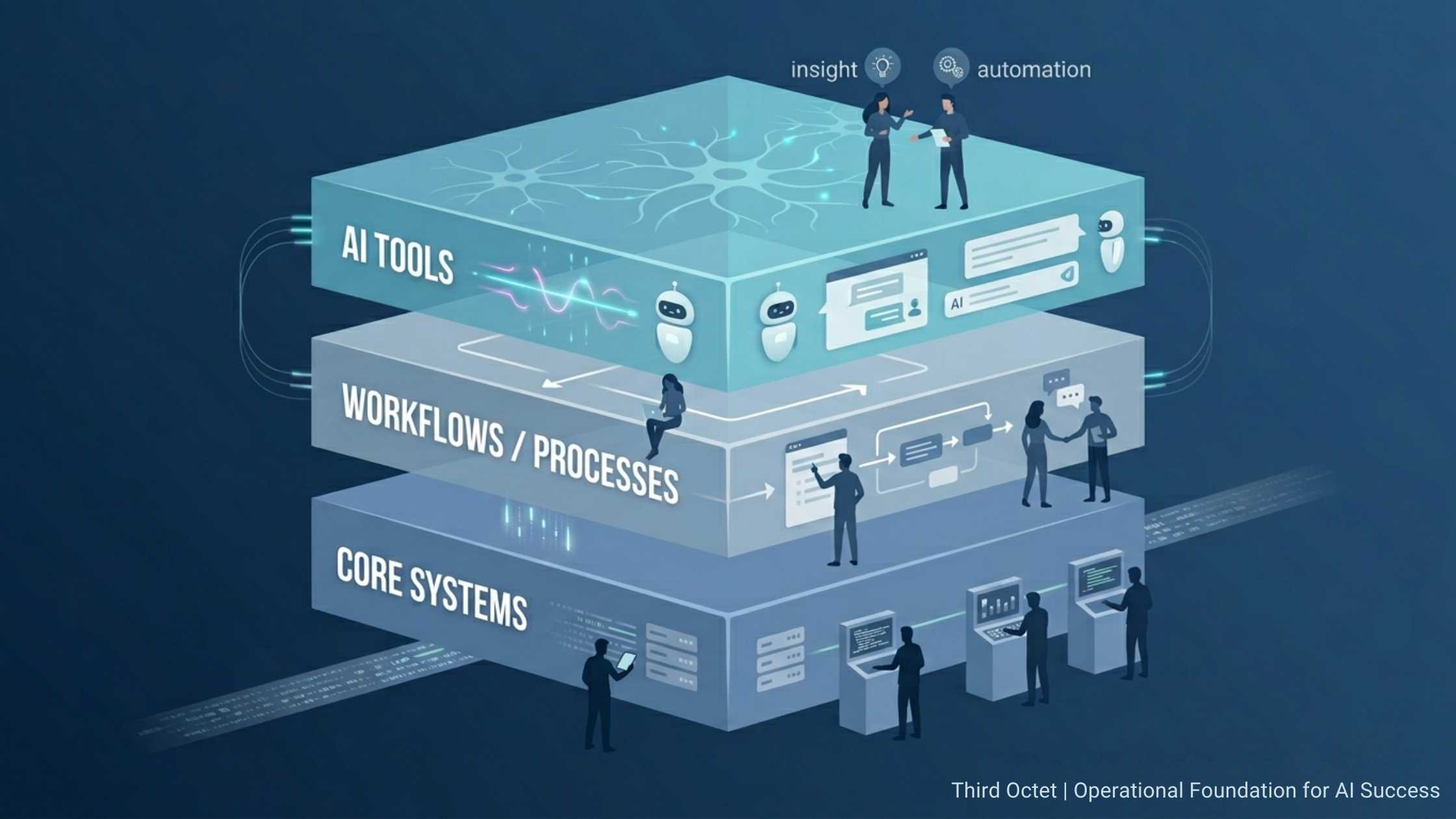
The stack: why AI is the final layer, not the first
Most AI initiatives start at the top: a feature gets enabled, a training session gets booked, and a few low-stakes tasks get faster. For a moment, it feels like progress.
Then momentum stalls.
That’s because AI is not the foundation. It’s the top layer.
Organizations getting the most from AI usually build in a more deliberate order.
1. Core technology stability
The core environment is standardized, secure, and supportable. Devices, identities, permissions, backups, and collaboration systems are managed intentionally, and Microsoft 365 or equivalent platforms are adopted consistently across the organization.
2. Operational visibility
Leaders and IT teams can see how systems and processes are actually being used. Bottlenecks, recurring issues, and inefficiencies are visible enough to act on, and reporting no longer depends on manual assembly.
3. Workflow automation
Routine work becomes more predictable. Onboarding, approvals, document routing, notifications, and other administrative processes are automated or standardized, so work no longer depends on memory or manual follow-up.
4. Data and knowledge readiness
Information is accessible, structured, and usable. Policies, documentation, historical context, and operational data live in systems people can search and use, reducing reliance on the one person who knows where everything lives.
5. AI augmentation
Only then does AI start delivering meaningful value, because it has cleaner inputs, defined workflows, and enough context to be useful.
AI doesn’t resolve operational ambiguity. It amplifies it. If workflows are unclear, documentation is inconsistent, and data is fragmented, AI may simply move the organization in the wrong direction faster.
When the foundation is solid, AI becomes a force multiplier.
That raises a more practical question: is your organization ready for it?
A quick AI readiness check for SMBs
In our experience, organizations that get the most from AI can usually answer most of these questions with confidence:
- Is my Microsoft 365 environment standardized, secured, and actively managed?
- Are my key workflows still mostly driven by email, memory, and manual follow-up?
- Can leaders access useful operational metrics without having to assemble them by hand?
- Is important knowledge stored in a way people can easily search, reuse, and trust?
- When someone leaves or goes on vacation, does work keep moving or slow down immediately?
- Are AI tools being tested in isolated pockets or applied within a more deliberate operating model?
If several of these raise concerns, the issue usually isn’t that your organization is behind on AI.
It’s not just about adopting AI; organizations need to ensure their operational layers-such as systems stability, process consistency, and data accessibility-are in place first. Addressing these areas is crucial for AI to be effective and avoid amplifying existing issues.
Curious how AI could actually deliver results in your organization? Book a quick 30-minute AI readiness review and see where stronger systems, workflows, and knowledge could make AI truly useful.
What this looks like in practice
In non-profits, accounting firms, and legal practices, AI tends to create the most value where teams are under time pressure, process friction is high, and better access to information improves responsiveness.
Non-profits: expanding capacity without expanding headcount
Non-profits operate under constant constraints. Demand grows faster than funding, and teams are asked to do more without growing at the same pace.
That is where AI can help, not by replacing people, but by reducing administrative drag:
- Grant writing and reporting
When program data is structured and outcomes are documented consistently, AI can help draft first-pass grant narratives and pull forward relevant metrics. - Donor communication
AI can help tailor updates based on donor history or engagement patterns, making it easier for small teams to communicate more consistently. - Board package preparation
When reporting is centralized and repeatable, AI can help assemble board materials faster so leadership spends less time gathering inputs.
These gains depend on consistent data, accessible reporting inputs, and documentation people can actually find and use. For non-profits, the value is usually straightforward: less manual effort, more consistency, and more capacity for high-value work.
Accounting firms: competing on responsiveness and depth
In accounting, the constraint is rarely expertise. It is time.
During busy periods, small inefficiencies compound quickly. Senior staff end up spending too much time on repeatable work that should be easier to move through:
- Inbox and communication triage
AI can help classify incoming client emails, surface routine requests, and support faster first responses. - Engagement letters and proposals
When client information and templates are structured, AI can help generate stronger first drafts more quickly. - Internal knowledge access
When prior work and firm guidance live in shared systems, AI can help staff find what they need faster and reduce the need to ask partners the same questions.
This only works when templates are standardized, documentation is accessible, and core systems are secure and consistently used. For accounting firms, the payoff is faster turnaround, less rework, and better use of senior expertise.
Legal practices: redirecting time toward higher-value judgment
Legal work is information-dense. Contracts, precedent, research, and internal notes all need to be located, reviewed, and applied carefully.
That is where AI can help, not by replacing legal reasoning, but by speeding up access to the information that supports it:
- Contract review and deviation detection
AI can help surface non-standard clauses and highlight areas that need closer review. - Matter intake and onboarding
When information is captured consistently, AI can help summarize new matters and support faster preparation of engagement documentation. - Research and precedent access
When prior work and internal knowledge are stored in structured systems, AI can help surface relevant material more quickly.
These wins depend on consistent document management, reliable access controls, and shared knowledge systems rather than scattered inboxes or personal folders. For legal practices, the value is not speed alone. It is creating more room for judgment, strategy, and client advisory work.
How Third Octet Helps Organizations Get Real Value from AI
The organizations getting the most from AI strengthen their operating environment first: systems, workflows, visibility, and knowledge. For non-profits, accounting firms, and legal practices, that is what turns AI from an experiment into something genuinely useful.
At Third Octet, we usually begin there: helping SMBs build the operational foundation that makes automation and AI worth investing in. The real work is not switching AI on. It’s building an environment where it can actually help.
That’s why our team at Third Octet helps organizations build the operational foundation that makes AI and automation truly effective. Book a 30-minute readiness review to discover how stronger systems, consistent workflows, and accessible knowledge can turn AI from an experiment into a productivity multiplier.



0 Comments