

A Business Owner’s Guide to IT by Company Size
Who’s fixing the Wi-Fi?
Picture this: It’s Monday morning. Payroll is due. The Wi-Fi is down. Suddenly, you’re not the CEO—you’re the Chief “Unplug-It-and-Plug-It-Back-In” Officer. Staff gather outside your office like it’s the Apple Store on launch day. Someone says, “Maybe Trevor in accounting can fix it! He built his own gaming PC once.”
That works… until it doesn’t.
Here’s the truth: IT isn’t just laptops and Wi-Fi anymore. It’s security. It’s compliance. It’s about ensuring your team can do their jobs without emailing you at 11 p.m., saying, “The server is on fire” (sometimes literally).
And as your business grows, your IT needs evolve. What worked at 10 people looks like duct tape at 50. What worked at 50 will buckle at 150. So how do you know when it’s time to keep DIY-ing, call in an MSP, or build your own IT team?
Let’s break it down by company size, with a story (and a smile) for each stage of growth.
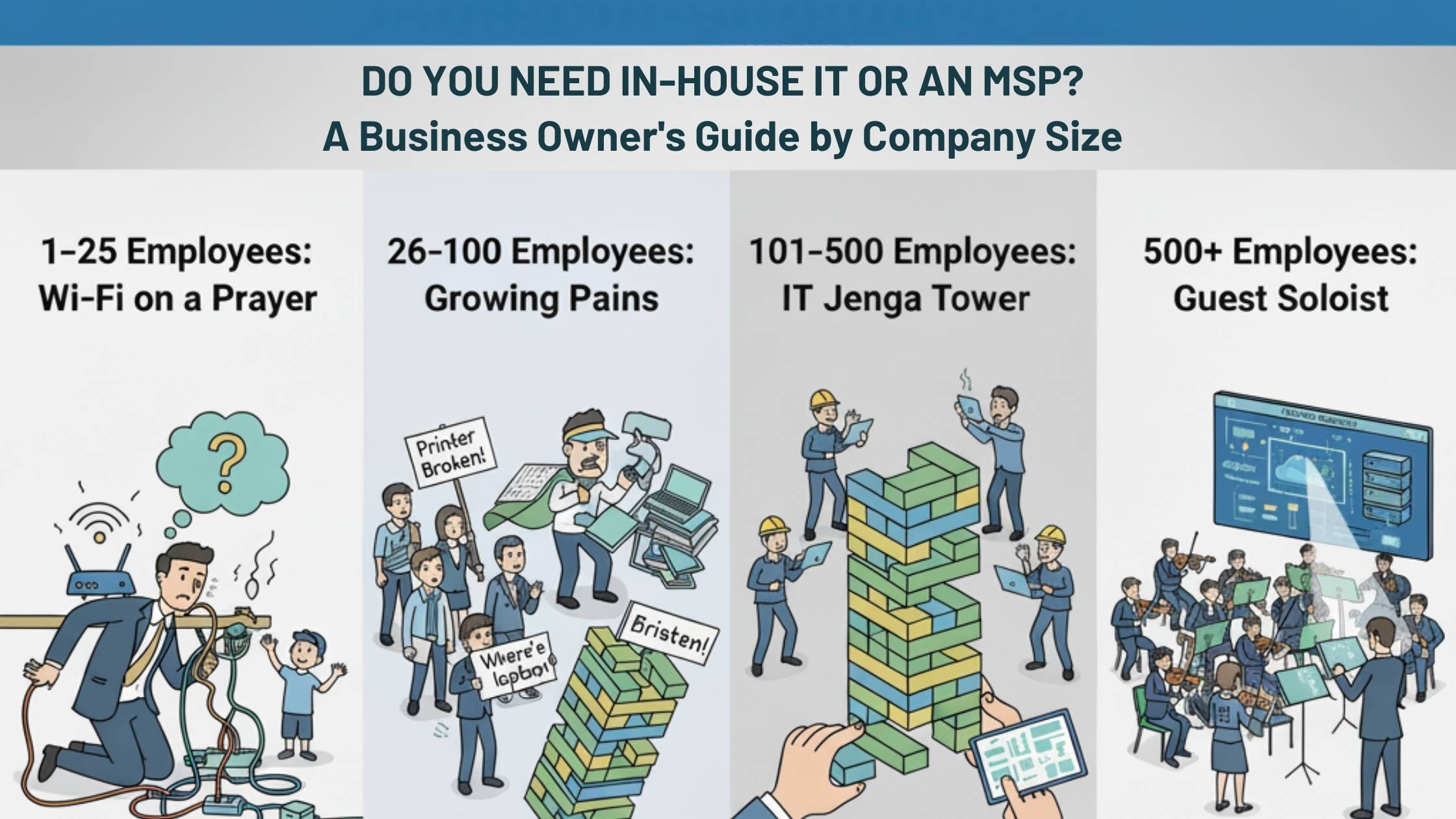
1–25 Employees: The Wi-Fi-on-a-Prayer Stage
“Your IT department is… you. And maybe your nephew.”
At this size, IT is usually whoever knows the Wi-Fi password. The owner sets up laptops, someone runs backups (sometimes), and your “cybersecurity policy” is essentially “don’t click on weird links.”
That works until you start to grow. Many businesses in this range rely on an independent IT consultant: someone they call when things break. That’s fine early on, but here’s when you should start planning to graduate to an MSP:
- Headcount growth: Hiring 3+ new people per quarter or planning to double in the next year.
- Compliance pressure: You need to meet privacy or insurance requirements.
- Recurring pain: IT fires are becoming monthly, not yearly.
- Strategic need: Technology is shifting from a cost to a growth enabler.
Best fit:
- If you’re under 20 people and growing slowly, a consultant may be enough.
- If you’re pushing past 20 and scaling, start exploring MSPs. You’ll need predictable costs, stronger security, and a team that grows with you.
26–100 Employees: The Growing Pains Stage
“Your accidental IT hero is out of capes.”
Here’s where the chaos really kicks in. You’re hiring fast, onboarding is messy, and your “accidental IT hero” (Trevor in accounting or the gamer in HR) is burning out. Laptops aren’t ready for new hires, tickets pile up, and leadership starts asking about compliance and cyber insurance.
This stage carries real risks:
- Budget blowouts: One crisis can cost more than a year of MSP coverage.
- Compliance pressure: PIPEDA and insurance requirements won’t wait for you to catch up.
- Single point of failure: If Trevor leaves, your IT leaves too.
- Scaling pain: Adding 10 new employees feels like climbing Everest.
Best fit: An MSP as your full IT department. Why?
- Predictable costs: Flat monthly fees instead of “oh no, the server died” bills.
- Compliance peace of mind: MSPs are already familiar with Canadian frameworks and insurance requirements.
- Depth of team: Help desk, security, and strategy, not just one overworked employee.
- Scalable onboarding: New hire? Laptop, email, and accounts are ready on day one.
Mini Case: A 50-person accounting firm in Ontario relied on a single consultant. When ransomware hit, recovery costs topped $250,000, far more than a year of MSP coverage. After switching, they cut emergencies by 60% in the first year and reduced cyber-insurance premiums by 15%. This is the sweet spot where MSPs deliver the biggest impact for Canadian SMBs.
101–500 Employees: The IT Jenga Tower
“One wrong move and the whole thing wobbles.”
You likely have one to three IT staff members. They’re capable but buried. Tickets never stop, projects like cloud migrations stall, and cybersecurity “will get done next quarter.”
Best fit: A co-managed model. Your internal IT team handles the day-to-day, while an MSP adds scale, expertise, and strategic planning. Think of it as turning your IT Jenga tower into a solid foundation.
For Larger Businesses (500+ Employees)
“Sometimes even an orchestra needs a guest soloist.”
At this level, you likely already have an IT department, which may include a CIO and a CISO. You don’t outsource IT; you partner for niche needs, such as cybersecurity, automation, or global rollouts.
Best fit: Internal IT runs the show. MSPs or consultants step in as specialists for high-impact projects.
Conclusion: Stop Playing IT Roulette
Here’s the thing: technology doesn’t care if you’re scrappy, growing, or global. When it breaks, it breaks. The only question is whether you’ve built the right safety net for where you are today.
- 1–25 employees: A consultant may cover the basics early on, but if you’re scaling or facing compliance needs, it’s time to plan for an MSP.
- 26–100 employees: An MSP as your full IT department provides predictable costs, compliance peace of mind, and the ability to scale without disruption.
- 101–500 employees: A co-managed IT model balances in-house staff with MSP expertise for scale, security, and strategy.
- 500+ employees: In-house IT leads, with MSPs or consultants supporting high-impact projects like cybersecurity, cloud, and compliance.
The real mistake? Trying to play yesterday’s IT game at today’s scale.
Your Next Step: 5-Minute Self-Assessment and a Free Guide
Are you unsure if IT is costing you time, money, or peace of mind?
Find out where you stand by taking our quick IT Self-Assessment. In just five questions, you’ll see whether you’re underinvesting, overspending, or right on track.
Once you’ve completed it, download our companion guide, How to Compare MSPs You Can Actually Trust, to learn what to look for when evaluating providers (based on your assessment results).
Because IT isn’t just tech, it’s your growth engine. The sooner you find the right model, the sooner you can stop putting out fires and start lighting up the scoreboard.


0 Comments