
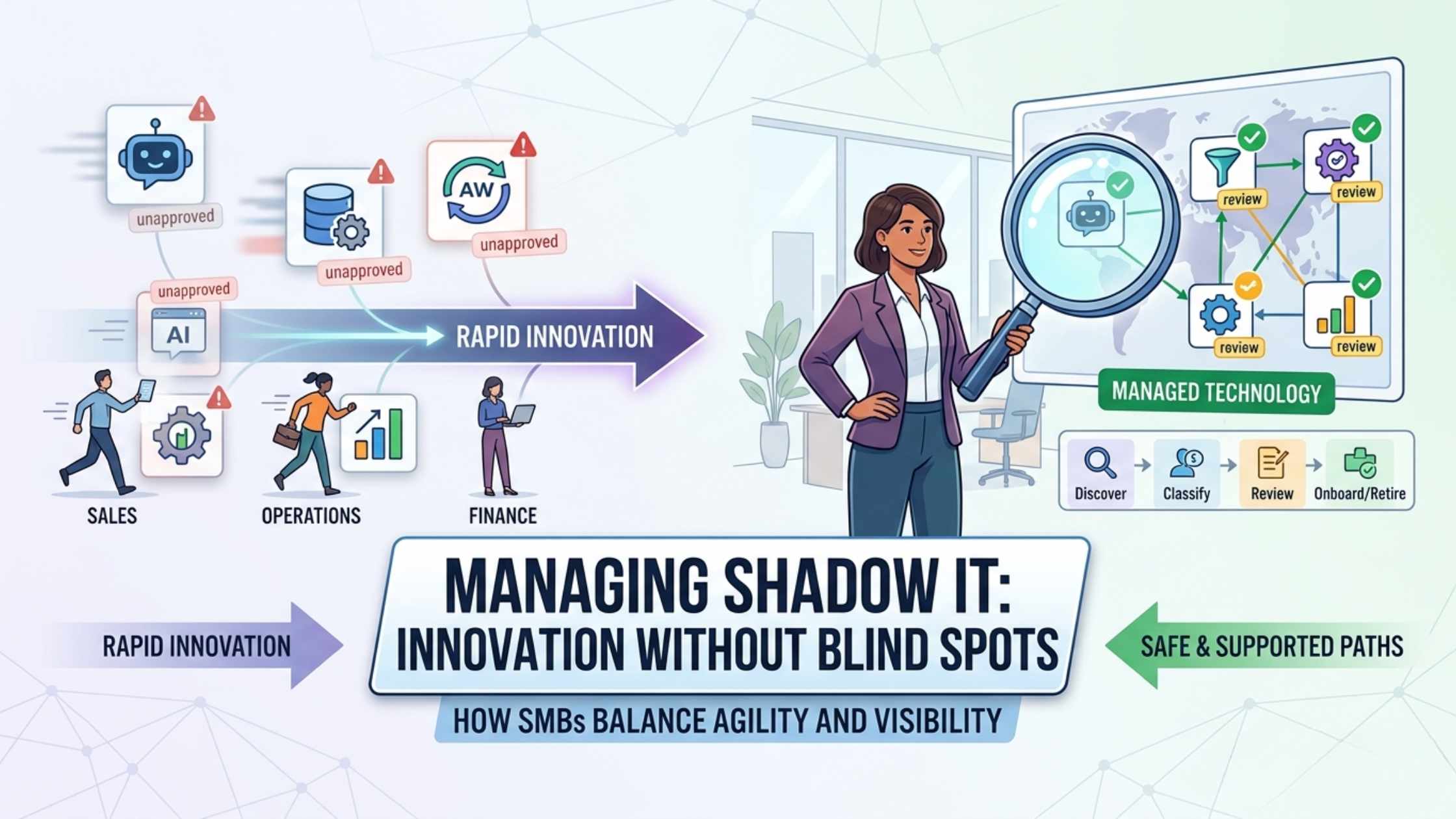

The Hidden Growth of Unsanctioned Tools
Teams are adopting new tools faster than most SMB leaders can realistically review them:
- A salesperson connects an AI assistant to meetings, notes, and follow-up.
- Operations builds a workaround in an unapproved app.
- Finance adopts a tool that solves a real problem, but no one has checked where the data goes, who owns it, or what happens if it fails.
That’s how shadow IT usually begins. It’s not a rebellious act, but rather a practical response to friction.
As we noted in How to Protect Your Business from Shadow AI, risk tends to build when adoption outpaces visibility. Shadow AI is one version of that. Shadow IT is the broader operating challenge underneath it.
What leadership can’t easily see
In SMBs, the pattern is familiar. Teams are under pressure to move. Internal support is lean. Formal reviews often lag behind actual work. So people find their own way forward.
At first, it just seems helpful. Work moves a little faster. A few people start relying on it. Then one day, something breaks, or a question arises, and leadership realizes no one has a full picture of where the data is going, how the tool fits into the business, or who owns the issue.
That is when IT has to untangle problems in tools it never properly brought into the environment, while duplicate spend and hidden risk continue to build.
Why blocking tools usually backfires
The instinct to lock things down is understandable.
But blanket restrictions usually create a different problem. It pushes activity further out of sight. People use personal accounts. They test tools informally. They work around slow approval paths because the business pressure to move has not gone away.
The organizations that handle this well do not treat every unsanctioned tool as a disciplinary issue. They create a better path.
A useful principle here:
Innovation is welcome. Invisibility is not.
That tells teams they can bring forward better ways of working, but not outside the organization’s line of sight.
What invisibility actually costs
The cost of shadow IT is often operational before it becomes dramatic.
You get overlapping subscriptions and duplicate tools. IT ends up supporting workflows it never knew existed. Data moves through systems that nobody has properly assessed. Employees bounce between too many apps, too many notifications, and too many half-connected ways of working.
Over time, the business starts paying for that lack of visibility in a few different ways:
- more friction when tools break or conflict
- more risk around identity, access, and data handling
- more spend gets tied up in overlapping tools and renewals
- less confidence in where important work actually lives
This is why shadow IT is not just an IT concern. It is also an operations, leadership, and business resilience issue.
What this looks like in practice
The answer does not need to be heavy. In most SMB environments, a lightweight process is enough to create much better visibility and control.
A practical model often looks like this:
Discover
Get visibility into what teams are already using, testing, or requesting.
Classify
Sort tools by what they touch. Identity. Sensitive data. Shared workflows. Automation.
Review
Some tools may only need to be logged and monitored. Others may need a quick review for security, compliance, supportability, and ownership.
Onboard or retire
Useful tools get documented, supported, and properly brought into the environment. Poor-fit tools get phased out before they create bigger problems.
The same principle applies here: make new technology visible early, review it proportionately, and create a path people will actually use.
That kind of approach is closer to how strong SMB environments actually operate. Not with endless approvals. Not with blind expansion. With enough structure to keep momentum from turning into a mess.
Why AI raises the stakes
AI has made this issue more urgent by shrinking the distance between experimentation and dependency.
A new tool may take time to spread. An AI assistant can become part of daily work almost immediately. It can shape how people summarize meetings, draft client communications, analyze information, or automate next steps before leadership has had much chance to weigh in.
That speed is part of the value. It is also why blind spots form so quickly.
Once AI enters the picture, the governance questions get more urgent. Where is data stored? Who can access it? Is the output now influencing customer, financial, or operational decisions?
That is why shadow AI tends to get attention first. But in many organizations, it really exposes a broader issue: there is no simple, trusted way to bring new technology to light before it becomes embedded in the work.
The goal: innovation without blind spots
Organizations can absolutely benefit from reducing unnecessary tool sprawl. But the bigger priority is making sure innovation does not outpace visibility.
When leaders lose sight of what tools are being used, where data is flowing, and which workflows depend on them, risk builds quietly in the background.
The strongest environments are not those with the shortest software lists. They are the ones where new tools can emerge without creating blind spots that the business cannot afford.
That is what innovation without chaos looks like in practice. Not perfect control, and not unrestricted sprawl. Just enough visibility for people to move forward without creating blind spots that the business cannot afford.
Where Third Octet fits
Third Octet helps organizations build a middle ground between “approve everything” and “block everything.”
In practice, that can mean surfacing what’s already happening, identifying where the real risk sits, and putting a lightweight review path in place so the business can move faster with fewer surprises.
For many organizations, the best first step is not a new policy. It is a clearer view of what is already happening.
Ready to see what’s already in play and what could become a problem?
Start your visibility review.



0 Comments