


Most business leaders say their IT provider is a 7 out of 10.
Not bad. Not great. Safe enough.
The problem with a “7”?
It hides real costs that chip away at your business every single day:
- Downtime employees don’t even bother reporting anymore
- Risks you won’t see until it’s too late
- Unpredictable invoices that derail your budget
At first glance, your MSP’s invoice may look manageable. However, the true cost becomes apparent in lost time, increased risk, and financial volatility.
1. Downtime & Lost Productivity = Missed Opportunity
A reactive MSP waits for things to break before stepping in. Meanwhile, your team is idling: unable to access files, log in, or complete tasks until someone intervenes.
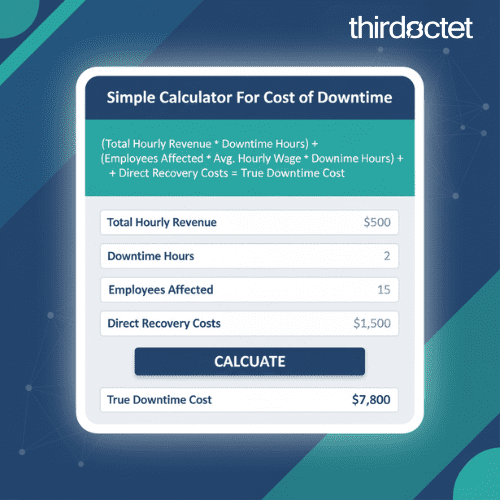
Small interruptions, ten minutes here and an hour there, add up quickly. Even if each incident feels relatively small, cumulatively, they cost you.
- For companies that value downtime at US $25,000 per hour, that’s still US $417 per server, per minute of disruption. (Calypix / ITIC)
2. Security & Compliance Gaps = Exponential Risk Exposure
Reactive IT often means patching after issues arise, weak monitoring, and a lack of strategic oversight. That’s where attackers (and auditors) slip in.
Consider these SMB-specific numbers:
- A breach at a small business typically costs between $120,000 and $1.24 million, depending on its severity. (Purplesec)
- Other studies show that SMB cyberattacks can cost anywhere from $25,000 to $3 million. (TechHeads)
- Even “smaller” incidents can hit from $826 to over $650,000, depending on complexity. (Astra Security)
And it’s not just about clean-up. These costs include:
- Regulatory fines and audit failures
- Lost business due to a weak compliance posture
- Damaged reputation and client trust
Example:
We worked with a Canadian professional-services firm that was scaling rapidly and winning larger clients. Their reactive IT provider had basic safeguards in place, but no proactive compliance or security planning. The result: they risked losing deals because they couldn’t meet client requirements.
By switching to a proactive MSP, that organization:
- Closed major security gaps before they became liabilities
- Passed complex audits with confidence
- Gained a partner who now acts as a virtual CIO, aligning IT with growth
Security cannot be postponed. Every gap is a potential breach waiting to happen.
3. Unpredictable Spend = Financial Volatility
Reactive IT looks inexpensive until emergencies start stacking up. Unexpected invoices arrive for:
- “Out-of-scope” support tickets
- Emergency fixes
- Last-minute audit preparation
- Breach cleanup
That’s not IT budgeting. That’s financial whack-a-mole.
By contrast, a proactive, fixed-cost (or all-inclusive) model brings:
- Predictable monthly fees
- No surprise invoices
- IT investment tied directly to outcomes
- Easier forecasting and financial discipline
If IT costs always catch you off guard, that’s a clear symptom of a reactive model.
What Proactive IT Actually Looks Like
A proactive MSP doesn’t wait for problems to arise. They prevent or mitigate them before you even see them.
Typical attributes include:
- Predictable monthly pricing, with no surprise add-ons
- 24/7 monitoring, patching, and preventive maintenance
- Regular security assessments, internal audits, and employee training
- Quarterly or semiannual strategy sessions to align IT with your business roadmap
- Clear metrics and accountability (SLAs, KPIs, business outcomes)
The difference: a partner that drives growth, security, and clarity, rather than one that merely “keeps the lights on.”
The Bottom Line
You might feel “okay” about your MSP. But if they’re reactive, you’re almost certainly carrying:
- Hidden productivity drag
- Unquantified security risk
- Budget surprises that erode financial control
At Third Octet, we believe IT should be a predictable, strategic asset, not a mysterious cost center.
If your MSP only shows up when things break, you’re paying too much in hidden costs you don’t see.
Let’s fix that. In under an hour, we’ll benchmark your IT health vs. SMB best practices, uncover your overspend risks, and deliver a scorecard with clear next steps.
Book Your Complimentary MSP Benchmark Assessment



0 Comments