
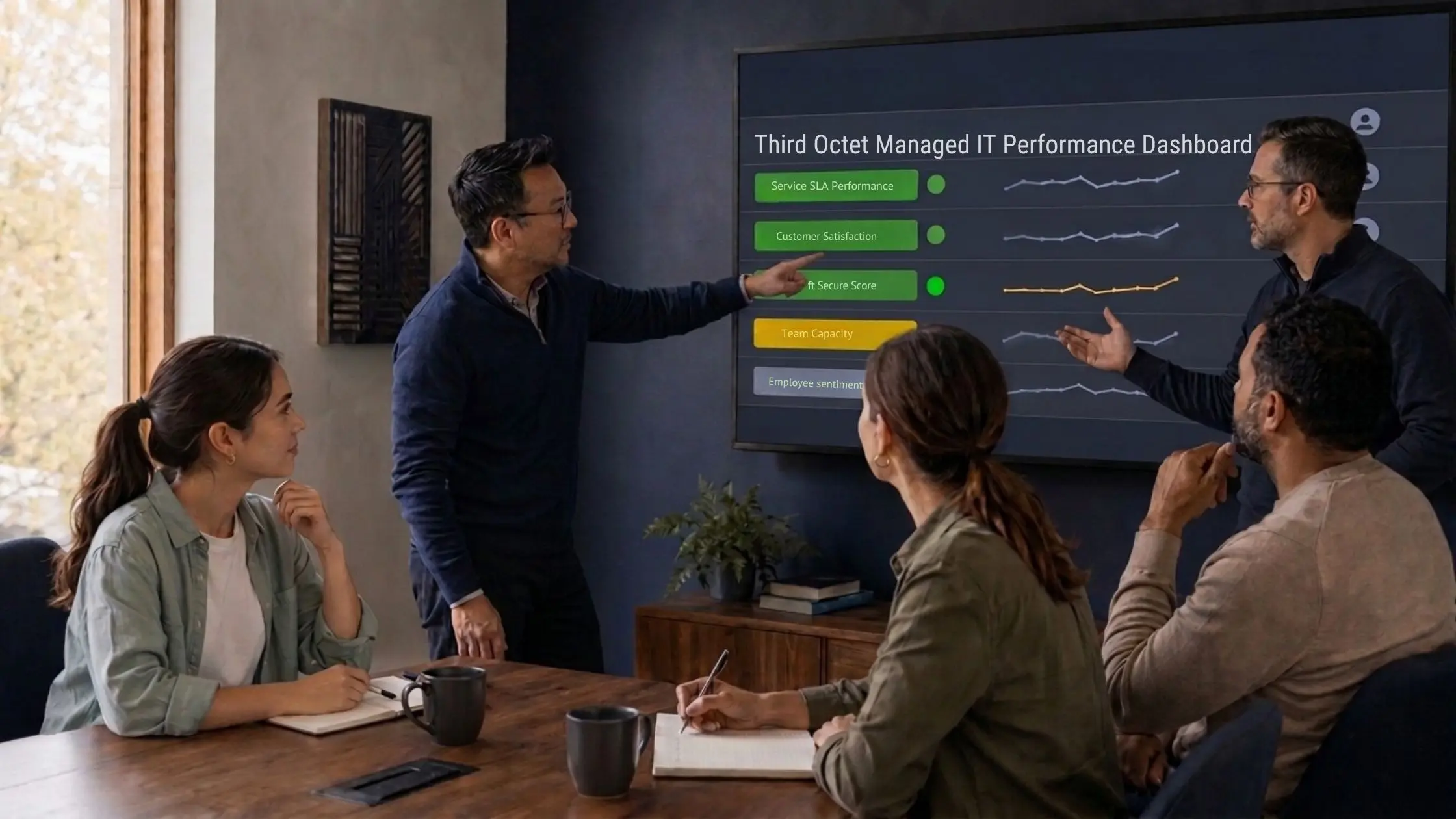

A well-run IT provider tracks a small set of measures with named owners and reviews them regularly. Five worth asking about: customer satisfaction (CSAT), SLA performance, Microsoft Secure Score, team utilization, and employee sentiment (eNPS). The key question to ask: “How do you measure whether our service is improving over time?”
How does an IT provider’s operating discipline affect your service?
Service scope, technical expertise, and price naturally receive close attention when you evaluate a managed IT provider. The provider’s internal operating discipline deserves the same scrutiny.
Most businesses have experienced missed follow-ups, slow responses, or issues that linger longer than they should. Sometimes the warning signs are quieter: no clear technology roadmap, security improvements that stay “on the list,” and little proactive guidance.
These can look like isolated service problems. Together, they may reveal how the provider operates behind the scenes. Unclear processes and ownership eventually show up in the customer experience.
That raises an important question: How does the company measure performance, assign responsibility, and improve when something falls behind?
At Third Octet, we use the Entrepreneurial Operating System (EOS), a practical set of tools for running a business, to create a consistent operating rhythm. EOS helps us set priorities, assign ownership, measure performance, and address problems when they surface.
Customers experience the effects through more consistent service, clearer communication, and steady attention to the health of their IT environment.
What should a well-run IT provider measure?
A well-run provider should be able to explain what it measures, why those measures matter, and how the findings lead to action.
EOS includes a weekly Scorecard that gives leadership teams a focused view of the numbers that matter most. Each measure has a clear owner and target, helping the team spot issues early and own follow-through.
At Third Octet, that discipline extends beyond a single scorecard. We use a combination of team, service, and security measures to understand how we are performing and where we need attention.
No individual measure can establish the overall quality of an IT provider. Together, these five indicators give us a more complete view of the service experience.
1. Employee sentiment: Employee Net Promoter Score (eNPS)
eNPS gives us one view of how employees feel about working at Third Octet. A supported, engaged team is better positioned to provide continuity, communicate clearly, and become familiar with each customer’s environment.
2. Customer feedback: Customer Satisfaction (CSAT)
After support interactions, CSAT gives customers a direct way to share their experience. We review individual responses and broader trends to understand what is working and where follow-up or improvement may be needed.
3. Microsoft 365 security posture: Microsoft Secure Score
Microsoft Secure Score helps us review how recommended security controls have been implemented within a Microsoft environment. It provides a useful baseline for identifying priorities and monitoring progress. Because it does not capture every security risk, we use it as one signal within a broader security review.
4. Team capacity: Team utilization
Team utilization helps us monitor workload and capacity across our engineering team. It can provide an early indication that work needs to be rebalanced or resources adjusted so customers continue to receive appropriate attention.
5. Service-level performance: SLA performance
We measure how consistently we meet defined response and resolution commitments. Trends can show where workflows, capacity, or escalation paths need attention and help us maintain a dependable service experience.
How should an IT provider act on its metrics?
Measurement creates value when it leads to action. Each week, our leadership team reviews the EOS Scorecard, flags measures that are off track, and determines what needs attention. A clear owner remains responsible for the next step and subsequent follow-through.
We use the same approach to manage customer environments. We review support patterns, system health, security posture, and planned improvements over time.
When a repeated issue, capacity concern, or security gap appears, we identify the next step, assign ownership, and monitor whether the response improves the result.
For customers, this should translate into fewer recurring problems, clearer priorities, and an IT environment that continues to improve over time.
How can you evaluate an IT provider’s performance?
If you are evaluating an IT partner or reviewing your current relationship, ask:
How do you measure whether our IT service and environment are improving over time?
A strong answer should include clear measures, a regular review cadence, named owners, and a process for addressing anything that falls behind. The specific metrics will vary, but the provider should be able to explain what it tracks, what the results show, and how those findings influence its actions.
Third Octet’s managed IT approach follows a clear path from understanding your current environment to establishing priorities, onboarding effectively, and continually improving your IT over time.
EOS / evaluating an IT provider FAQs
What KPIs should an MSP report to clients?
There’s no single required list, but a well-run provider should be able to explain what it measures, why those measures matter, and how the results lead to action. Common measures include customer satisfaction (CSAT), performance against response and resolution commitments (SLAs), security posture indicators such as Microsoft Secure Score, team capacity or utilization, and employee sentiment (eNPS). Ask for a named owner and a regular review cadence for each.
How often should you review performance with your IT provider?
Internally, a provider should review its measures on a fixed rhythm. At Third Octet, our leadership team reviews the EOS Scorecard weekly. With you, we review support patterns, system health, security posture, and planned improvements [monthly / quarterly — confirm what you actually offer]. The right cadence is whichever one makes sure issues get an owner and a next step before they become recurring problems.
What is EOS?
The Entrepreneurial Operating System (EOS) is a practical set of tools for running a business. It helps a company set priorities, assign ownership, measure performance with a weekly Scorecard, and address problems when they surface. At Third Octet, we use it to keep our service delivery consistent.


0 Comments