
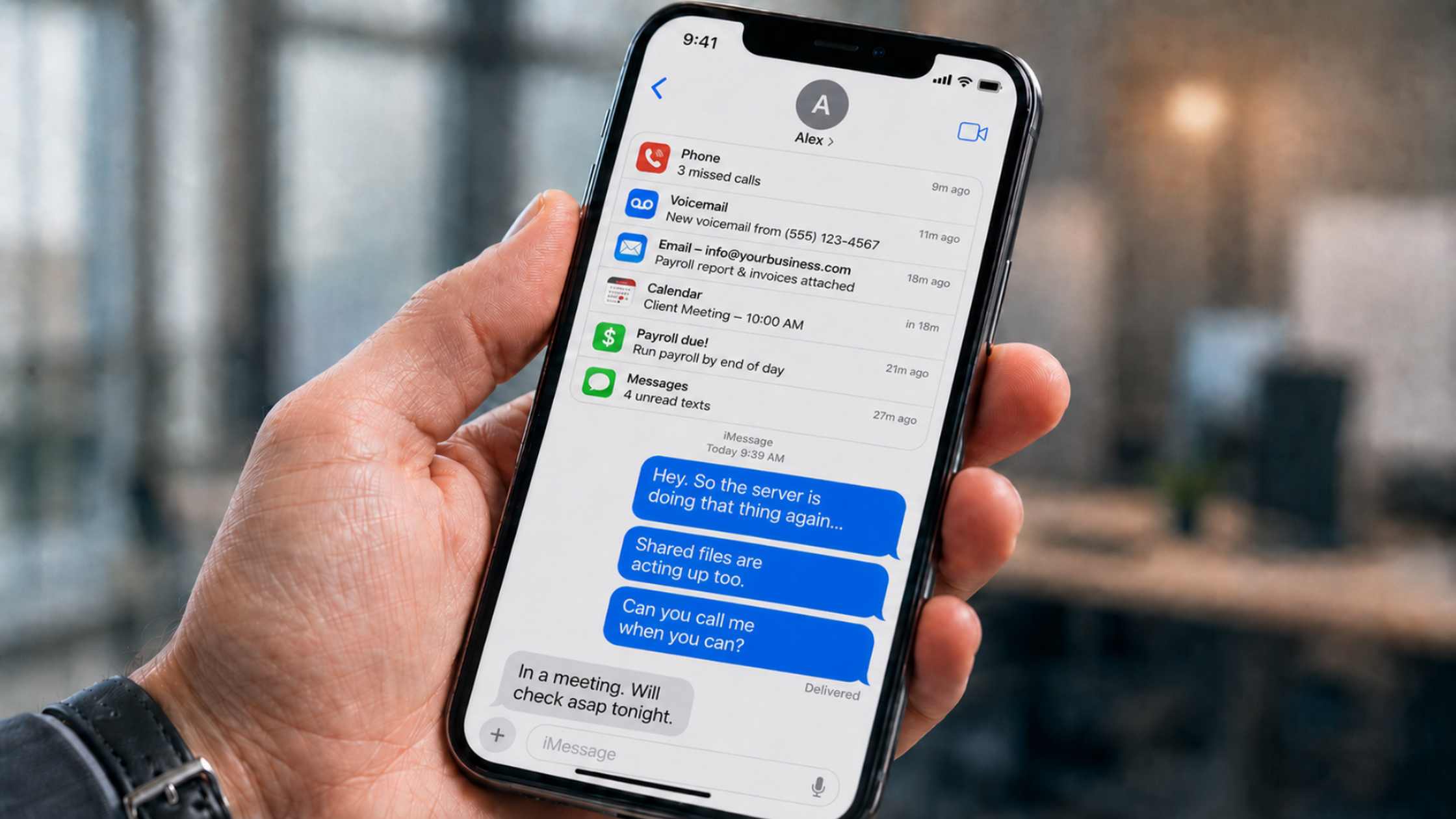

Relying on a single IT person is risky because requests, history, and system knowledge live in their phone and head instead of a tracked system. If they’re away, there’s no record, no backup, and no accountability for response times. Structured support keeps the personal touch while letting anyone on the team step in.
Why is relying on one IT person risky?
It’s one of the most common things we hear from people evaluating an IT provider, or reflecting on what they liked about their previous one:
“I just want to be able to call someone who knows how we do things.”
It comes from a good place. You’ve had frustrating experiences with faceless help desks, ticket queues that feel like you’re shouting into a void, or support teams that make you re-explain your setup every time you call. You want a real person. Someone who picks up the phone. Someone who understands your business. Someone who just knows.
We get it. And we’re not going to tell you that instinct is wrong.
But building your IT support model around a single person creates a common and often overlooked risk we see in small and mid-sized businesses.
The comfort of a go-to IT contact
At some point, you found someone who understood your environment, responded quickly, and made problems go away. Naturally, you started going to them directly. A quick text, a personal email, maybe even a call to their cell.
It worked. It felt efficient and personal. For a while, it probably was.
Meanwhile, your support model was becoming increasingly dependent on that relationship. Most businesses don’t think much about the vulnerability this creates until something goes wrong.
What gets lost when IT requests go through texts and calls?
When a request goes directly to one person rather than through a structured support channel, the issue may still get resolved. Which is why the habit’s so easy to justify.
But it can also create risks that are hard to see in the moment:
Context may not get captured
A quick text can solve the immediate problem, but unless it enters a system, it may leave no formal record behind:
- No ticket
- No written request
- No clear history of what was tried
- No documentation of what changed
That may not matter today. But if the same issue returns next week and your usual contact is away, someone else may have to reconstruct the situation from scratch. Without a fallback person, you could be facing an unknown amount of downtime.
Triage can get bypassed
Not every request needs the same urgency, skill set, or escalation path.
A structured intake process helps route issues to the right person at the appropriate priority. A direct text usually lands on one person’s plate, even when they’re already handling something critical for another customer.
Accountability becomes harder to see
When a request lives in someone’s text thread, it’s harder to track:
- Whether it was received
- Who owns it
- When it should be escalated
- Whether response commitments are being met
- Where the issue stands
That person may still handle it well. But your business has less oversight if something gets missed.
Your “bat phone” still depends on someone answering
Your usual contact isn’t sitting by their phone waiting for your call. They may be working in another environment, attending meetings, handling escalations, or occasionally on vacation.
The irony is that what first felt like premium, personalized service can become a fragile, undocumented process. It works well until it doesn’t, often at the moment when you most need dependable support.
Keeping the human element
Structured support doesn’t have to mean faceless ticket portals and automated responses. Nobody wants that, and we don’t run our company that way.
Our engineers know our customers’ environments, including their history, quirks, and operational realities. We actively invest in those relationships and build that institutional knowledge across the team.
Our systems are intentionally designed so that essential knowledge doesn’t live in one person’s head.
When a request comes through our established support channels, it’s logged with the relevant details and routed according to priority and skill set. Its progress is tracked, and the work is documented so another engineer can step in with a clear understanding of what has already happened.
If your usual engineer is unavailable, the experience doesn’t have to fall apart. The information and accountability needed to continue the work are already built into the process.
A simple test
Here’s a quick way to evaluate your current IT support model:
If your go-to IT person went on holiday tomorrow, how much of what they know about your environment would effectively go with them?
Feeling uneasy about the answer is understandable. What matters is whether your business has a system that allows the right people to step in when needed.
That’s an entirely fixable systems problem.
Still unsure? See whether in-house IT or an MSP is the better fit →
What does resilient IT support look like?
A resilient IT support model doesn’t rely on a single point of contact. The provider has built a system that delivers consistent results without relying on any one person being available.
That means every request is captured and tracked. Response times are measured against real commitments, with clear SLAs and escalation paths, rather than “I’ll try to get to it today.” Engineers can review your environment documentation and service history before they pick up an issue. You can also see every open item, helping prevent requests from falling through the cracks.
This is what operational discipline looks like at the service delivery level. It’s not flashy. It doesn’t come with a personal cell phone number.
But it provides something one individual can’t offer alone: continuity when circumstances change.
The relationship you actually want
You want to feel known. You want fast responses. You want support that understands your business and doesn’t make you start over every time.
That kind of experience comes from familiarity supported by the right processes, shared knowledge, and accountability.
When those pieces are built into service delivery, your business isn’t left hoping the right person answers. You can trust that each issue will be understood, routed, and resolved without losing momentum.
That’s what reliable IT support should feel like.
FAQs
What is a single point of failure in IT support?
It’s when your IT support depends on one person, so if they’re unavailable, support slows or stops. Common signs include requests sent by text or personal email, no tickets or written history, and nobody else who knows how your environment is set up.
What happens if my IT person is unavailable or leaves?
If the knowledge lives only in their head, someone else has to reconstruct your environment and its history from scratch, which can mean an unknown amount of downtime. With structured support, requests are logged, routed by priority and skill, tracked, and documented, so another engineer can step in with a clear understanding of what has already happened.

0 Comments