
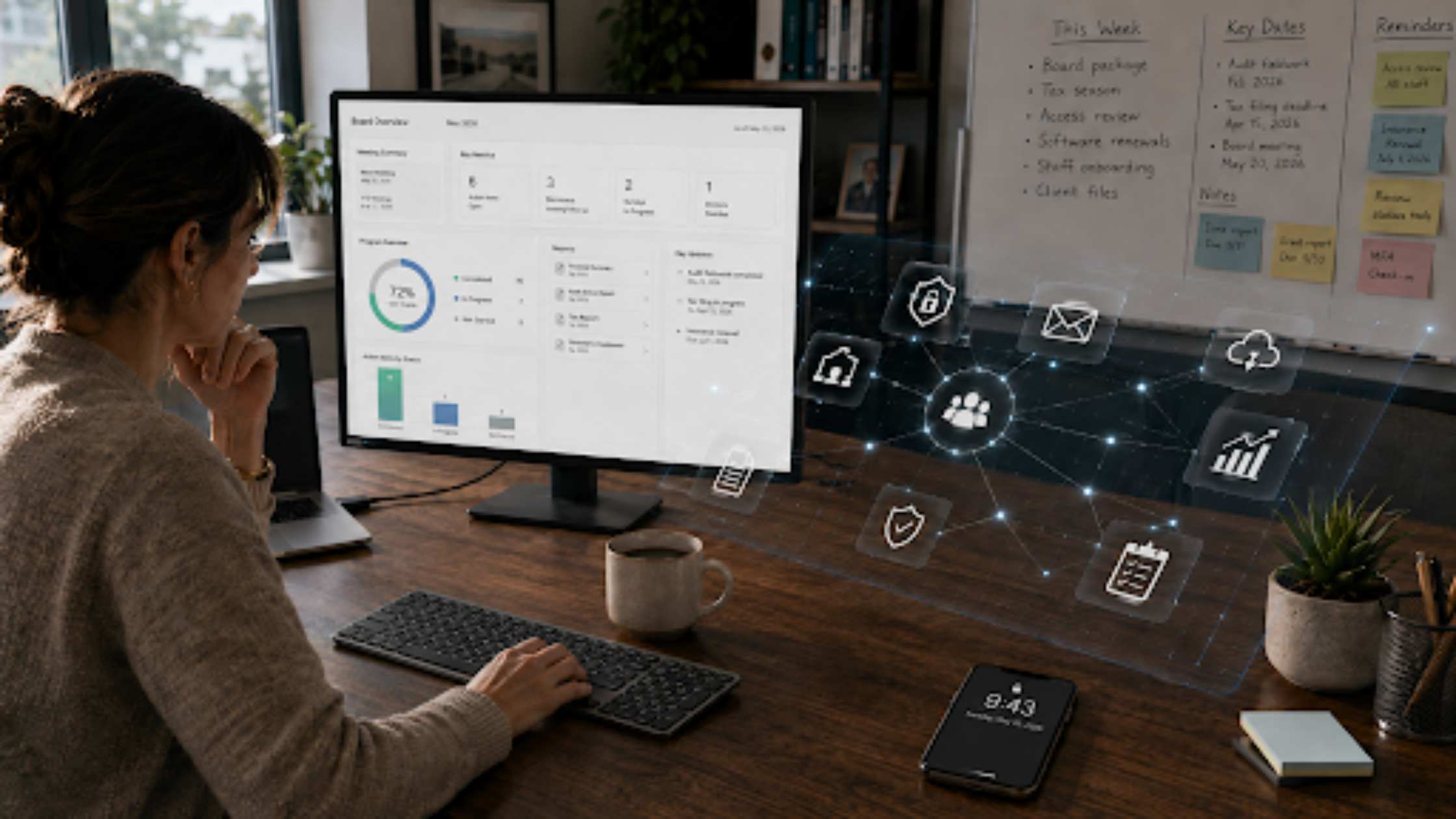

Most organizations think they know what their IT provider manages.
Devices. Email. The network. Security. Backups. Support tickets.
And technically, they’re right.
Those things are covered. Tickets get resolved. Patches get applied. Accounts get created. The Wi-Fi stays on.
But that definition leaves out the part that matters most to the business: how technology actually supports the way people work.
That’s where the gap appears.
It’s the space between infrastructure that functions and an operating environment that helps people move faster, make better decisions, and trust the systems around them.
Confidence erodes when everyday tools feel harder to use than they should, when information lives in too many places, and when small inefficiencies become part of how the organization operates.
Your managed IT provider may be doing exactly what the contract says.
The contract may simply not be asking enough.
The comfortable definition
If you asked most managed IT service providers to describe their scope, you’d probably hear something familiar.
They monitor infrastructure. Maintain endpoints. Manage cloud environments. Respond to tickets. Apply security controls. Keep systems available.
None of that is wrong.
It’s essential work.
But it mostly describes the mechanics of IT. The plumbing. The foundation. The things that need to run reliably in the background so the organization can function.
What it doesn’t describe is the layer in which work actually happens.
The moment when a new employee tries to understand where things live.
The moment when leaders decide what to fund, what to fix, and what to stop doing.
Traditional managed IT services were built to keep systems running.
It wasn’t designed, on its own, to make work better.
What falls through the cracks
This is where the limits of the traditional model start to show.
A collaboration platform can be managed and still create more noise than clarity.
Licenses can be active and still no longer reflect how the organization works.
New hire accounts can be created on time, while onboarding remains inconsistent from one person to the next.
Security controls can be in place, while employees quietly adopt their own tools, buy subscriptions on credit cards, or move data through systems no one has formally reviewed.
None of this usually looks like a failed IT relationship.
It looks like day-to-day work.
That’s why these issues are so easy to miss. They sit between operations and technology, close enough to affect the business, but not always obvious enough to appear in a ticket queue or quarterly review.
So people adapt.
They create workarounds. They rely on memory. They build small fixes around bigger gaps.
The real cost of the gap
The gap shows up as friction.
A team spends 15 hours preparing a board package because the right reporting views were never connected.
An accountant manually reclassifies the same emails every tax season because no one has stepped back to ask whether the process could be structured.
An executive director can’t easily see what software the organization is paying for, who still uses it, or whether half the stack is solving problems that no longer exist.
A managing partner knows the firm has good tools, but still sees people saving files inconsistently, duplicating work, and relying on the same few employees to remember how everything fits together.
None of these issues looks dramatic from the outside.
But they compound.
Over time, friction becomes culture. People stop expecting systems to help them. They build their own spreadsheets, their own shadow processes, their own shortcuts. They learn where the workarounds are, then teach them to the next person.
Meanwhile, the IT provider continues to resolve tickets.
The machines are healthy. The inboxes work. The dashboards look fine.
But the operating model underneath the work is still broken.
The workarounds are the warning sign
We’ve seen this play out in nonprofit environments where capable teams are working with more systems than they have time to coordinate.
In one case, an executive director and finance lead spent hours each month manually preparing board reports because the information they needed was scattered across inboxes, spreadsheets, and disconnected systems.
Nothing was technically “broken,” but the process was draining time from work that mattered more.
Once the environment was reviewed as a working system, not just a set of tools, the opportunity became clearer: simplify the reporting flow, reduce manual handling, and give leaders a more reliable view of the information they needed to support board-level decisions.
What managing IT should actually mean
Managing IT shouldn’t stop at uptime and security.
Those things are essential. They matter deeply. But they’re not the whole picture.
The deeper question is whether the organization’s technology environment is helping people do the work they’re actually there to do.
That requires a different kind of visibility.
A patched device tells you one thing. It doesn’t tell you whether people are using the tools in front of them well.
An active license tells you something. It doesn’t tell you whether that spending still reflects how the organization works today.
A closed ticket may solve the immediate issue. It doesn’t always reveal the pattern behind it, or why the same friction keeps returning.
Microsoft Secure Score is one useful signal here. It can show whether parts of the Microsoft environment are configured securely. But even strong security signals don’t answer the larger operating question on their own.
That’s why strong tools without a plan behind them can still leave an organization exposed. The issue isn’t always whether the technology exists. It’s whether the business has the visibility, ownership, and operating habits to use it well.
The technology your organization runs on isn’t a utility. It’s an operating layer.
And operating layers need to be designed, measured, and continuously improved. Not simply maintained.
A different way to think about the relationship
At Third Octet, this is part of how we think about the modern workplace: not as a collection of tools, but as a layered system that needs to work together.
There is the foundation: the tools, devices, infrastructure, security posture, and support model. This is the part most organizations already understand. It’s also the part most managed IT relationships are designed around.
But above that foundation, there are other parts of the system that matter just as much.
Organizations need a clearer view of what’s happening across their environment: where tools are being used well, where spend is drifting, where adoption is uneven, and where activity points to a bigger operational issue.
They also need to identify the repetitive work that quietly consumes time. Manual routing. Recurring email triage. Reporting tasks. Processes that were acceptable when the organization was smaller, but now create drag every week.
And they need a more strategic conversation about where the environment should go next. What to invest in. What to simplify. What to retire. What to redesign. What risks are worth addressing now, before they become urgent?
This is also where issues like shadow tools employees adopt on their own become more than a security concern. They become a sign that the workplace system is evolving faster than the business can see, govern, or support.
When leaders start looking at technology this way, the question changes.
It’s no longer only, “Is our IT working?”
It becomes, “Is our IT working for us?”
That’s a much more useful question.
The question worth asking
Here’s one way to test the relationship.
If your managed IT provider disappeared tomorrow and you hired a new one, what would actually change?
If the honest answer is “mostly the name on the invoice,” that tells you something.
It tells you the relationship is transactional.
Transactional relationships don’t make organizations better. They just keep the lights on.
There’s nothing wrong with keeping the lights on. Every organization needs reliable support, secure systems, and people who can respond when something breaks.
But if that’s where the relationship ends, the organization is leaving too much value on the table.
The teams that get the most from technology are not always the ones with the biggest budgets or the newest tools. They’re the ones who stop treating IT as a background service and start treating it as part of how the organization operates.
That shift doesn’t start with a product.
It starts with a better conversation.
One that goes beyond tickets and uptime to ask what the organization is actually trying to accomplish, where work is getting harder than it needs to be, and how technology can support the business more deliberately.
That’s the difference between a provider who closes tickets and one who builds relationships that go beyond tickets and uptime.
That’s the conversation we want to have.


0 Comments