

A team is in a meeting. Someone says, “We should really be using AI.” A few people nod. The owner nods too. And then there’s a small pause, because nobody in the room can actually say what they’d use it for.
If you’ve sat in that meeting, you’re not alone. It happens in a lot of rooms right now. The pressure to be “using AI” arrives well before anyone has a clear problem for it to solve.
There’s a more useful question hiding underneath the nodding. Not “should we use AI,” but “what work is actually slowing us down, and does anyone have it written down?”
That second question is where automation starts. And it’s the step most businesses skip.
What’s the difference between automation and AI?
Automation and AI are not the same thing, and treating them as interchangeable is where a lot of SMB projects go sideways. Automation is about making repeatable work run on its own. AI is one tool you might use inside that work – usually when a step involves reading, sorting, or making a judgment.
Here’s the distinction in plain terms.
|
Automation Rules-driven Execution |
AI Pattern-Driven Reasoning |
|
| What It Is | Repeatable steps that run without someone doing them by hand | Software that reads, classifies, or generates based on patterns |
| What It Needs | A Process you’ve defined – clear steps, clear order | Good inputs and a defined job; it amplifies whatever it’s pointed at |
| In Practice | New Hire Onboarding: Equipment requests, accounts, and payroll all fire in sequence | Inside that Workflow: An inbound email gets read and sorted to the right queue as one step |
| Common Mistake | Buying the tool before writing down the steps | Reaching for AI to fix a process nobody has defined yet |
So the relationship is simpler than the hype makes it sound. AI is one tool you might use inside an automated process. That’s the whole relationship. It’s not a separate project, and it’s not a substitute for understanding how your work actually flows.
If you want the longer view on where automation fits in a business, that’s the heart of running repeatable work within guardrails.
The step most businesses skip
Automation projects fail for a boring reason: nobody wrote down how the work actually happens before the tool got purchased. The software shows up, and then the real work – figuring out the steps – begins under pressure, with a licence already on the meter.
I’ve watched a version of this play out more than once. A team buys a tool to automate a recurring process. It gets set up. Then everyone sits down to configure it and discovers nobody agrees on what the steps actually are. Who does what, in what order, with which exceptions. The tool sits half-configured for months while the manual work quietly continues alongside it.
You can’t automate what you don’t understand.
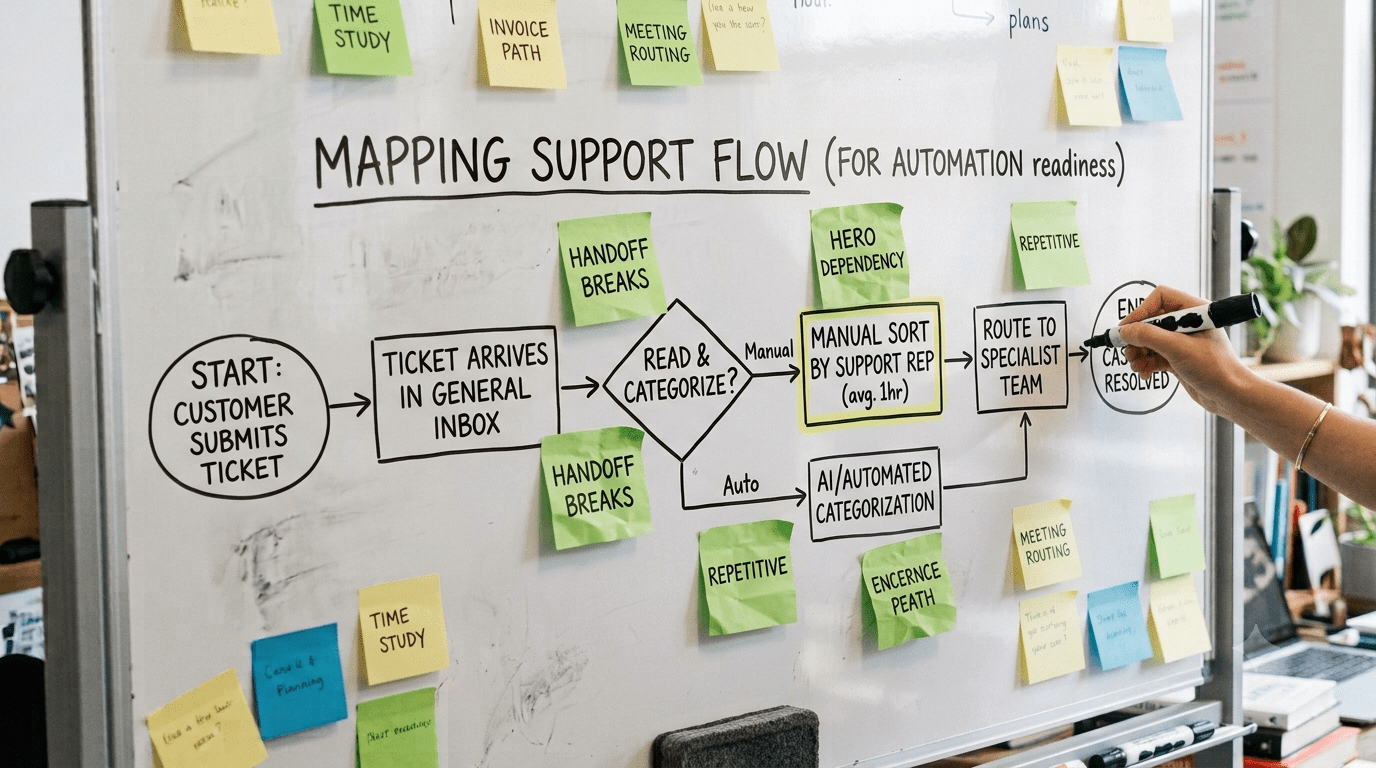
Documenting the work sounds heavier than it is. This isn’t a formal process map or a consultant’s workshop. It’s writing down the steps as they actually happen – who does what, where it slows down, and where the handoff between people breaks. The goal is to make the work visible, not to make it pretty.
This is the same trap behind hero dependency, where the only person who knows how something works is the one person you can’t afford to lose. When the steps live in someone’s head, you don’t have a process. You have a risk. We wrote about that in the hidden risk of relying on a single internal hero.
How do you prepare a process for automation? (3 steps)
You can do the first useful work this week, with no software purchase, no consultant, and no process-mapping workshop. It takes a notepad and an honest look at how the week actually goes.
1. List the repetitive work. The tasks that happen every week, involve more than one person, and consistently take longer than they should.
2. Write down the steps. Not a diagram – a list. Include where it slows, where someone has to chase someone else, and where the answer lives in one person’s head instead of in a system.
3. Circle the handoff that breaks most often. That’s usually where automation adds value first. Not the most complex part of the work. The most consistently painful one.
AI fits in here somewhere, and it’s usually in step three. If the handoff that keeps breaking involves reading, sorting, or classifying information – invoices needing to be categorized, meeting notes that have to be routed to the right person – that’s where AI tends to earn its keep. But you only see that clearly once the steps are written down.
Now put a number to it.
You’ve identified where work is slowing down. The next question is: how much is that inefficiency actually costing you?
Our free Workflow Waste Calculator estimates the time and annual labour cost tied up in repetitive work — and helps identify which workflows may be worth tackling first.
Innovation with AI is still on the table, just downstream
None of this means putting AI experimentation on hold. It means the experimentation gets concrete instead of hypothetical. Once the process work is visible, the conversation changes from “we should use AI” to “this step takes 45 minutes of manual sorting every day – could AI do that?”
That’s the difference between undirected enthusiasm and responsible exploration. The nod in the meeting is fine. What changes after you’ve done the process work is that the nod gets followed by a real question: “Which process are we talking about?”
This is also why curiosity alone isn’t readiness. Saying you use AI and being set up to use it well are two different things, which we get into in We use AI” is the new “we moved to the cloud. And if you’re wondering where AI genuinely moves the needle in service businesses, our look at AI in non-profits, accounting, and legal makes the point that AI amplifies whatever process it’s pointed at, for better or worse.
Want to see where workflow waste is costing your team?
AI and Automation FAQs
What’s the difference between AI and automation?
Automation makes repeatable work run on its own by following steps you’ve defined. AI is software that reads, classifies, or generates based on patterns. AI is often one step inside an automated process – not a replacement for it.
Do I need to document my processes before automating?
Yes, at least informally. You don’t need a formal process map, but you do need to write down how the work actually happens before you buy a tool. Automation projects most often stall because nobody agreed on the steps first.
What should a small business automate first?
Start with repetitive work that happens every week, involves more than one person, and consistently takes longer than it should. Then look for the handoff that breaks most often. That’s usually where automation adds value first, rather than the most complex part of the work.
How do I know if a process is ready to automate?
You can write down the steps as they actually happen: who does what, in what order, where it slows down, and which exceptions come up. If people disagree about the steps, or the answer lives in one person’s head, document and agree on the process first. Automation projects most often stall because nobody agreed on the steps before the tool was bought.


0 Comments